China is advancing its space program with the development of Qingzhou, a next-generation cargo spacecraft designed to efficiently resupply its Tiangong space station. This new vehicle represents a shift towards more agile and cost-effective orbital logistics as China plans to maintain a permanent human presence in space for at least the next decade.
The Need for Supplemental Cargo Capacity
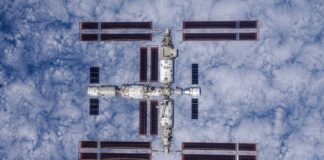
The Tiangong station, completed in 2022, requires a steady flow of supplies, equipment, and experimental payloads. China’s existing Tianzhou spacecraft currently handles these deliveries, but the Qingzhou project aims to complement this capability with a smaller, lighter, and potentially cheaper alternative. Expanding Tiangong beyond its current three-module structure will necessitate more flexible resupply options. This ensures the station remains fully operational and capable of supporting long-duration missions.
Qingzhou’s Key Specifications
Developed by the Innovation Academy for Microsatellites of the Chinese Academy of Sciences (IAMCAS), the Qingzhou prototype measures approximately 3.3 meters in diameter and has a launch mass of around 5,000 kilograms. It can carry up to 1,800 kilograms of cargo to orbit.
The spacecraft’s design features a unique hybrid structure:
- A pressurized module for essential crew supplies and delicate scientific instruments.
- An unpressurized aft section for external payloads and experiments exposed directly to space.
This combination enhances versatility, allowing for both internal station support and external research opportunities.
Development Timeline and Launch Plans
According to a recent report from China Central Television (CCTV), the Qingzhou spacecraft recently passed its design review and has entered initial manufacturing. Deputy Chief Designer Wu Huiying confirmed that testing is proceeding well:
“We have now conducted large-scale experiments… The overall test results are quite good.”
Full engineering model production is slated to begin in early 2026, with completion by the end of that year. The debut flight will be scheduled based on Tiangong’s operational needs.
Initial plans called for the first prototype to launch on the maiden flight of CAS Space’s Kinetica-2 commercial rocket, but reports now indicate that CAS Space is preparing for that launch independently from Jiuquan spaceport.
Implications for China’s Space Program
The Qingzhou spacecraft is more than just a cargo delivery system; it demonstrates China’s commitment to sustained space exploration and its growing independence in orbital logistics. By diversifying its resupply options, China strengthens its ability to operate the Tiangong station reliably for years to come, while also creating opportunities for rapid deployment of new technologies and experiments. The development signals a strategic move to ensure long-term viability in low Earth orbit.