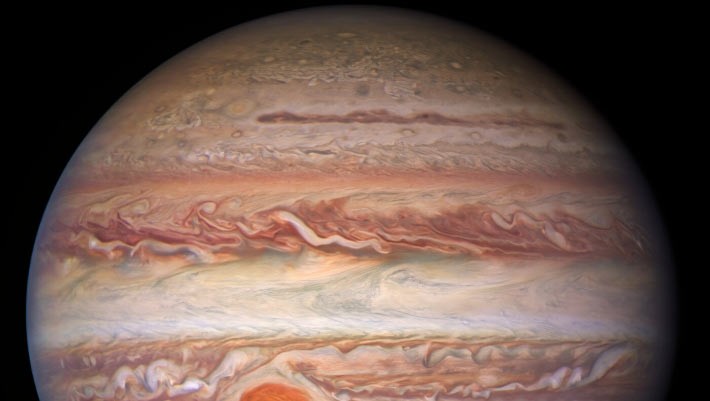
New data from NASA’s Juno mission have refined our understanding of Jupiter’s size and shape, revealing the planet is notably smaller and more “squashed” than earlier estimates suggested. The findings, published in Nature Astronomy, demonstrate a significant improvement in measurement accuracy thanks to high-precision radio-occultation techniques and the inclusion of previously unaccounted-for zonal wind effects.
Refining Jupiter’s Dimensions
For decades, Jupiter’s dimensions were based on data from the Pioneer and Voyager missions of the 1970s. These earlier measurements, while foundational, lacked the precision now achievable with modern instrumentation. The Juno spacecraft, orbiting Jupiter since 2016, has allowed scientists to probe the planet’s interior through radio signals, providing a clearer picture of its true form.
The latest analysis reveals Jupiter’s polar radius is approximately 66,842 kilometers, while its equatorial radius reaches 71,488 kilometers. The mean radius is 69,886 kilometers. These measurements are 12 kilometers smaller at the poles, 4 kilometers narrower at the equator, and 8 kilometers smaller overall compared to previous estimates. This correction isn’t merely a refinement of numbers; it indicates our understanding of gas giant structure has been incomplete.
The Role of Rotation and Wind
Jupiter’s shape is an oblate spheroid, flattened at the poles and bulging at the equator due to its rapid rotation (a day on Jupiter lasts just under 10 hours). The centrifugal forces generated by this spin counteract gravity, causing the equatorial bulge. However, Jupiter’s interior density isn’t uniform. Density increases dramatically from less than 1 kg/m³ in the cloud tops to thousands of kg/m³ deep inside, creating latitudinal variations in the gravity field.
Adding to this complexity, Jupiter’s powerful zonal winds also influence the planet’s shape. These winds modify centrifugal forces, causing further variations, up to 10 kilometers, especially near the equator. Previous models didn’t fully account for these atmospheric effects, resulting in less accurate estimates.
How the Measurements Were Made
The Juno mission utilized radio occultation, a method of “seeing” through Jupiter’s dense clouds by beaming radio signals back to Earth. As these signals pass through the ionosphere, they bend and delay due to atmospheric gases. By precisely measuring the frequency shifts caused by this bending, scientists can determine temperature, pressure, and electron density at different depths. This technique allows for detailed internal structure analysis where direct observation is impossible.
Why This Matters
The improved understanding of Jupiter’s dimensions has implications for planetary science. Accurate measurements are critical for modeling Jupiter’s internal structure, magnetic field, and atmospheric dynamics. These factors influence the entire Jovian system, including its moons and radiation belts. Better shape data also refine our understanding of how gas giants form and evolve.
These findings underscore the value of ongoing planetary exploration. While previous missions laid the groundwork, the precision of modern instruments like Juno continues to challenge and refine our knowledge of the solar system.
The improved data will serve as a baseline for future Jupiter observations and may provide insights into the behavior of other gas giants, both within our solar system and beyond.