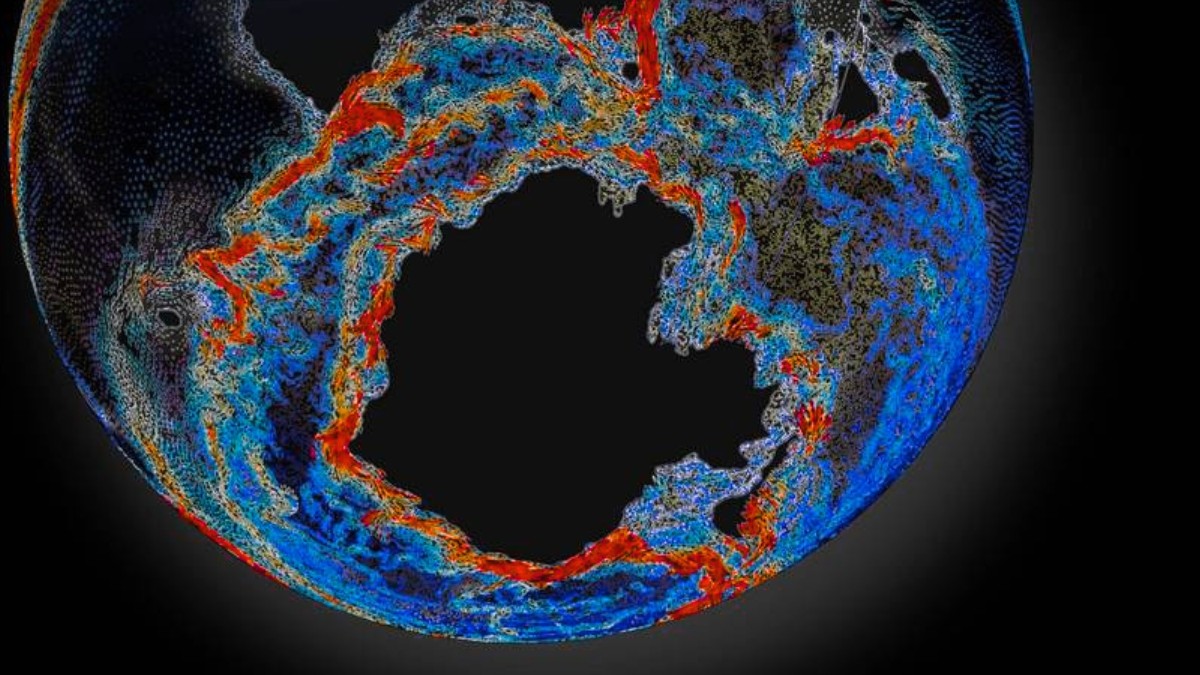
New climate simulations have revealed that the birth of the Antarctic Circumpolar Current (ACC) was not a simple consequence of shifting continents. Instead, it required a precise alignment of geological movement and atmospheric force to transform a fragmented flow into the global powerhouse that regulates our planet’s climate today.
The Engine of the Global Ocean
The ACC is a massive, clockwise-moving current that circles Antarctica. To put its scale into perspective, it is five times stronger than the Gulf Stream. Beyond its sheer power, the ACC acts as a vital link in the “global conveyor belt,” a system of ocean currents that redistributes heat, nutrients, and salt across the world’s oceans.
For decades, scientists believed the current began forming roughly 34 million years ago as Australia and South America drifted northward, opening new maritime passageways around Antarctica. However, new research from the Alfred Wegener Institute (AWI) suggests that geography alone was not enough to complete the circuit.
The Missing Piece: The Tasman Gateway
Using advanced climate models, researchers simulated Earth’s conditions from 33.5 million years ago—a period when the planet was transitioning from a “greenhouse” state to a cooler “icehouse” state. By factoring in ocean depths, CO2 levels, and landmass positions, they discovered a crucial bottleneck in the current’s development.
The simulations revealed that while a “proto-ACC” existed, it was unable to complete a full loop around the continent. Instead, the current would split and dissipate near the coasts of Australia and New Zealand.
The reason for this failure was atmospheric interference:
– Winds blowing off the East Antarctic Ice Sheet collided with the westerly winds in the Tasman Gateway (the gap between Antarctica and Australia).
– This collision prevented the current from gaining the momentum needed to circle the continent.
– The circuit only became “complete” once Australia migrated far enough north to align the westerly wind belt perfectly with the Tasman Gateway.
“Only when Australia had moved further away from Antarctica and the strong westerly winds blew directly through the Tasman Gateway, the current could fully develop,” explains Hanna Knahl, a climate modeler at AWI.
A Stabilizer Under Threat
Once fully established, the ACC became a primary architect of Earth’s climate stability. By creating a fast-moving barrier, it effectively insulates Antarctica from warmer northern waters, helping to maintain the permanent ice sheets that have existed for millions of years.
However, this ancient stabilizer is currently facing modern pressures:
1. Southward Migration: As global temperatures rise, the ACC is shifting southward, bringing warmer waters into direct contact with Antarctic ice.
2. The Freshwater Feedback Loop: Melting ice is dumping massive amounts of fresh water into the ocean. This reduces salinity, which can weaken the current’s flow.
3. The 2050 Risk: Recent projections suggest the ACC could slow by 20 percent by 2050. A weaker current would struggle to block warm water, leading to even faster ice melt—a dangerous “vicious cycle.”
Why Looking Backward Matters
While the Earth of 34 million years ago was vastly different from today, studying its “infancy” provides essential clues for predicting our future. By understanding how the ACC responded to historical drops in CO2 and shifting winds, scientists can better model how our current, high-CO2 environment will disrupt the ocean’s most critical circulation system.
Conclusion: The formation of the Antarctic Circumpolar Current was a perfect storm of continental drift and wind alignment. Today, as human-induced warming threatens to disrupt this delicate balance, understanding its historical origins is vital to predicting the future of the global climate.