NASA’s Hubble Space Telescope has delivered a stunning new image of the star-forming region NGC 1333, revealing the chaotic, energetic process of stellar birth. This observation provides crucial insights into how stars and planetary systems originate.
The Early Stages of Star Formation
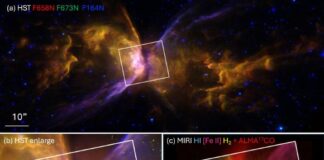
Stars aren’t born fully formed; they begin as dense clumps within vast clouds of gas and dust. Gravity pulls this material inward, creating a protostar – a star still in the process of growing, actively feeding on the surrounding cloud. The recent Hubble image captures this exact stage, showcasing a protostar within NGC 1333 along with other young stellar objects.
Dynamic Growth and Disruption
Protostars are not passive; they grow in fits and starts, gulping down material while simultaneously ejecting powerful outflows of wind and jets. This creates a constant interplay between accretion and disruption, carving out cavities in the surrounding clouds. This process shapes the environment that future stars and planets will inherit.
The image reveals two dark stripes flanking the bright point of the growing star. These are the shadows of a protoplanetary disk, a critical structure where planets may eventually form. Light leaking from the star reflects off dust grains, creating a phenomenon known as a reflection nebula.
Location and Significance
NGC 1333 resides within the Perseus molecular cloud, approximately 950 light-years from Earth. Studying regions like this is vital for astronomers seeking to understand the finer details of star formation. By observing these areas in infrared and visible light, researchers can reveal different aspects of this complex process.
Recent high-resolution observations of protostellar jets have uncovered “time stamps” – bursts of activity that correlate with changes in material flow. This shows that star growth isn’t a smooth, continuous process but rather episodic.
Understanding how stars form is fundamental to understanding our own origins. Every rocky planet, ocean, or atmosphere began with the same basic ingredients: gas, dust, gravity, and time.
Images like this don’t just show how stars form; they reveal how their dynamics shape the universe around us. The process of star formation is a violent, dynamic, and ultimately essential part of cosmic evolution.