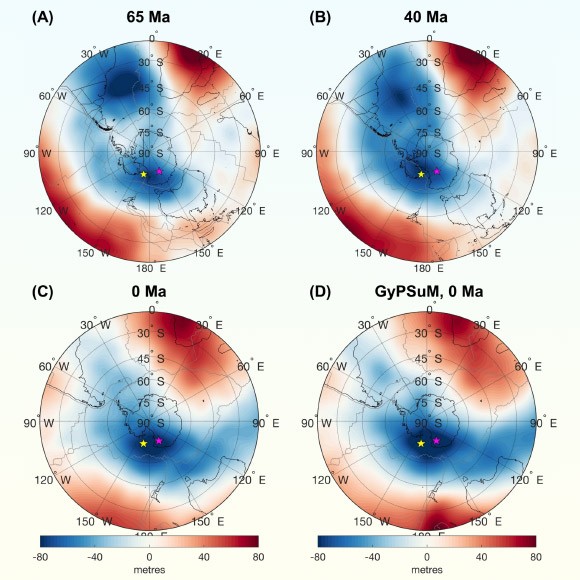
New research reveals that Antarctica’s extreme gravity anomaly, known as the Antarctic Geoid Low, isn’t a sudden phenomenon but the result of slow, subterranean rock movements stretching back tens of millions of years. Geoscientists from the University of Florida and the Institut de Physique du Globe de Paris have mapped the development of this gravity hole through the Cenozoic Era (the last 66 million years), shedding light on a key process that influences both sea levels and ice sheet stability.
What is the Antarctic Gravity Hole?
The Antarctic Geoid Low is the most pronounced gravity anomaly on Earth. Differences in rock density deep below the surface create variations in gravity, though small in absolute terms, they have significant effects on ocean height. Where gravity is weaker, the sea surface dips slightly as water flows towards areas with stronger gravitational pull. This means that around Antarctica, sea levels are measurably lower than they would be otherwise.
How Did Researchers Trace Its Origins?
Researchers used a combination of global earthquake recordings and physics-based modeling to reconstruct a 3D picture of Earth’s interior. The process is analogous to a CT scan, but instead of X-rays, they used earthquake waves to illuminate the planet’s hidden structure. By accounting for all detectable rocks and using predictive models, scientists reconstructed a gravitational map that closely matched satellite data.
Then, they ran the simulations backward, effectively “rewinding” the flow of rock over 70 million years. This revealed that the gravity hole wasn’t always so strong; it gained prominence between 50 and 30 million years ago.
The Connection to Climate Change
The timing of this strengthening gravity anomaly coincides with major climate shifts in Antarctica, including the onset of widespread glaciation. Researchers now aim to determine if there’s a direct causal link between the gravity hole and the growth of ice sheets.
“The ultimate goal is to understand how processes deep inside our planet connect to climate changes on the surface,” explains Professor Alessandro Forte of the University of Florida.
This research highlights that Earth’s interior isn’t static, but actively shapes the environment we live in. Understanding these dynamics is crucial for predicting how sea levels and ice sheets will behave in the future.
The study, published in Scientific Reports in December 2025, offers a powerful example of how geophysics can unlock mysteries buried deep within our planet.
P. Glišović & A.M. Forte. 2025. Cenozoic evolution of Earth’s strongest geoid low illuminates mantle dynamics beneath Antarctica. Sci Rep 15, 45749; doi: 10.1038/s41598-025-28606-1