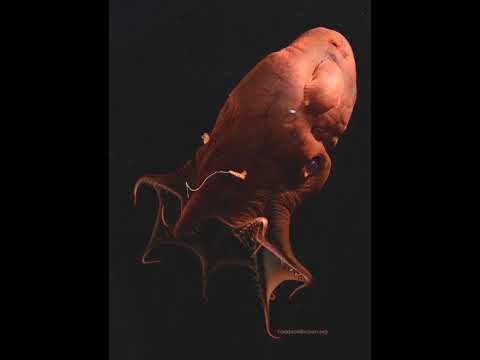
The genome of the vampire squid (Vampyroteuthis sp. ) has been fully sequenced, revealing it to be one of the largest animal genomes ever analyzed—exceeding 11 billion base pairs. This discovery provides a critical missing link in understanding the evolution of cephalopods, the group including squids, octopuses, and cuttlefish. The research, published in iScience on November 21, 2025, confirms that the vampire squid occupies a unique “intermediate” position between the modern octopus and squid lineages.
A Living Fossil’s Genomic Secrets
The vampire squid is a deep-sea creature inhabiting oceans worldwide at depths of 500–3,000 meters. Unlike typical squids and octopuses, it reproduces multiple times throughout its life, a trait suggesting a more primitive reproductive strategy. Despite its name, the squid has eight arms like an octopus but genetically shares more traits with squids and cuttlefish. This makes it a valuable “genomic living fossil,” preserving key features of cephalopod evolution.
The research team, led by Masa-aki Yoshida of Shimane University, sequenced the genome from a specimen collected in the West Pacific Ocean. The genome’s size is roughly four times larger than the human genome, yet exhibits a surprisingly well-preserved chromosomal structure. This preservation is significant because modern octopuses underwent extensive chromosomal rearrangements during evolution, whereas the vampire squid retained a more ancestral organization.
Why This Matters: Rewriting Cephalopod History
For over 300 million years, cephalopods have split into two major groups: the ten-armed squids and cuttlefish (Decapodiformes) and the eight-armed octopuses (Octopodiformes). The vampire squid’s genome provides the first clear chromosomal-level evidence of this divergence.
Early cephalopods were likely more squid-like than previously assumed. The vampire squid’s genome suggests that the common ancestor of octopuses and squids had a squid-like chromosomal structure that later fused and compacted into the modern octopus genome—a process known as “fusion-with-mixing.” This large-scale chromosomal reorganization, rather than new genes, appears to be the primary driver of cephalopod diversity.
Key Findings and Future Implications
Researchers also sequenced the genome of the pelagic octopus Argonauta hians (paper nautilus) for comparison. The analysis shows that the vampire squid preserves genetic heritage predating both lineages. The findings challenge long-held assumptions about cephalopod evolution, suggesting that the divergence between octopuses and squids was driven by major chromosomal changes rather than genetic innovation.
“Our study provides the clearest genetic evidence yet that the common ancestor of octopuses and squids was more squid-like than previously thought,” said Dr. Emese Tóth of the University of Vienna.
The sequencing of these genomes is expected to revolutionize understanding of cephalopod evolution, providing a foundation for further research into the genetic mechanisms behind their remarkable adaptations. This discovery underscores the importance of preserving “living fossils” like the vampire squid, which hold clues to the deep evolutionary history of life on Earth.