Astronomers have, for the first time, directly observed a key aspect of planet formation: an exoplanet’s atmospheric composition mirroring that of its host star. The study, published on February 18, 2026, in Nature Communications, confirms a long-held assumption that planets inherit their chemical identity from the protoplanetary disks where they originate. This finding provides critical validation for models used to understand the formation of both gas giants and rocky exoplanets.
The Ultra-Hot Jupiter WASP-189b
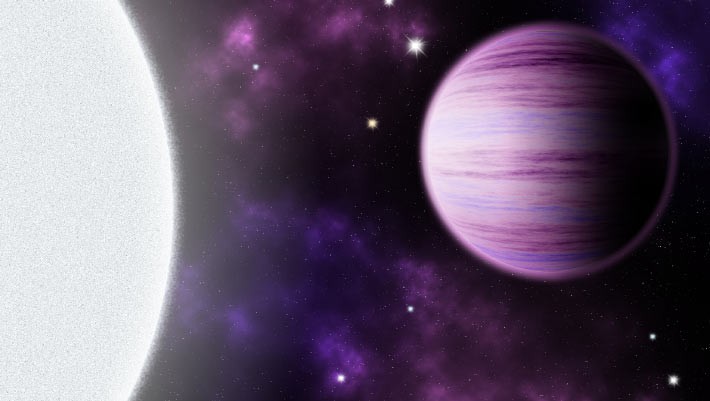
WASP-189b, a gas giant 1.6 times the size of Jupiter, orbits a massive A-type star (HD 133112) located 322 light-years away in the Libra constellation. This star is significantly hotter and larger than our Sun, reaching temperatures exceeding 2,000 degrees Celsius. The planet’s extreme proximity to its star – just 20 times closer than Earth to the Sun – results in a scorching orbital period of only 2.7 days.
Breakthrough in Atmospheric Analysis
The research team, led by Jorge Antonio Sanchez at Arizona State University, used the Immersion Grating Infrared Spectrometer (IGRINS) on the Gemini South telescope to analyze WASP-189b’s atmosphere. The instrument allowed for high-resolution measurements of thermal emission spectra, revealing the presence of neutral iron, magnesium, silicon, water, carbon monoxide, and hydroxyl.
Crucially, the study found that WASP-189b’s magnesium-to-silicon ratio matches that of its host star. This direct observational evidence supports the theory that protoplanetary disks – the birthplaces of planets – retain the same elemental composition as their stars.
Why This Matters
Previous understanding of this stellar-planetary chemical link relied primarily on observations within our Solar System. The confirmation on an exoplanet opens new avenues for studying planet formation elsewhere. The extremely high temperatures of WASP-189b allow for easier detection of vaporized rock-forming elements, which would otherwise be obscured on cooler planets.
“WASP-189b gives us a much-needed observational anchor in our understanding of terrestrial planet formation,” explains Sanchez.
The ability to measure these elements with ground-based spectrographs represents a significant advancement in exoplanet research, allowing for more accurate modeling of rocky planet composition and formation mechanisms.
The study underscores the importance of high-resolution spectroscopy in unraveling the mysteries of exoplanetary atmospheres, and promises to refine our understanding of how planets form across the galaxy.