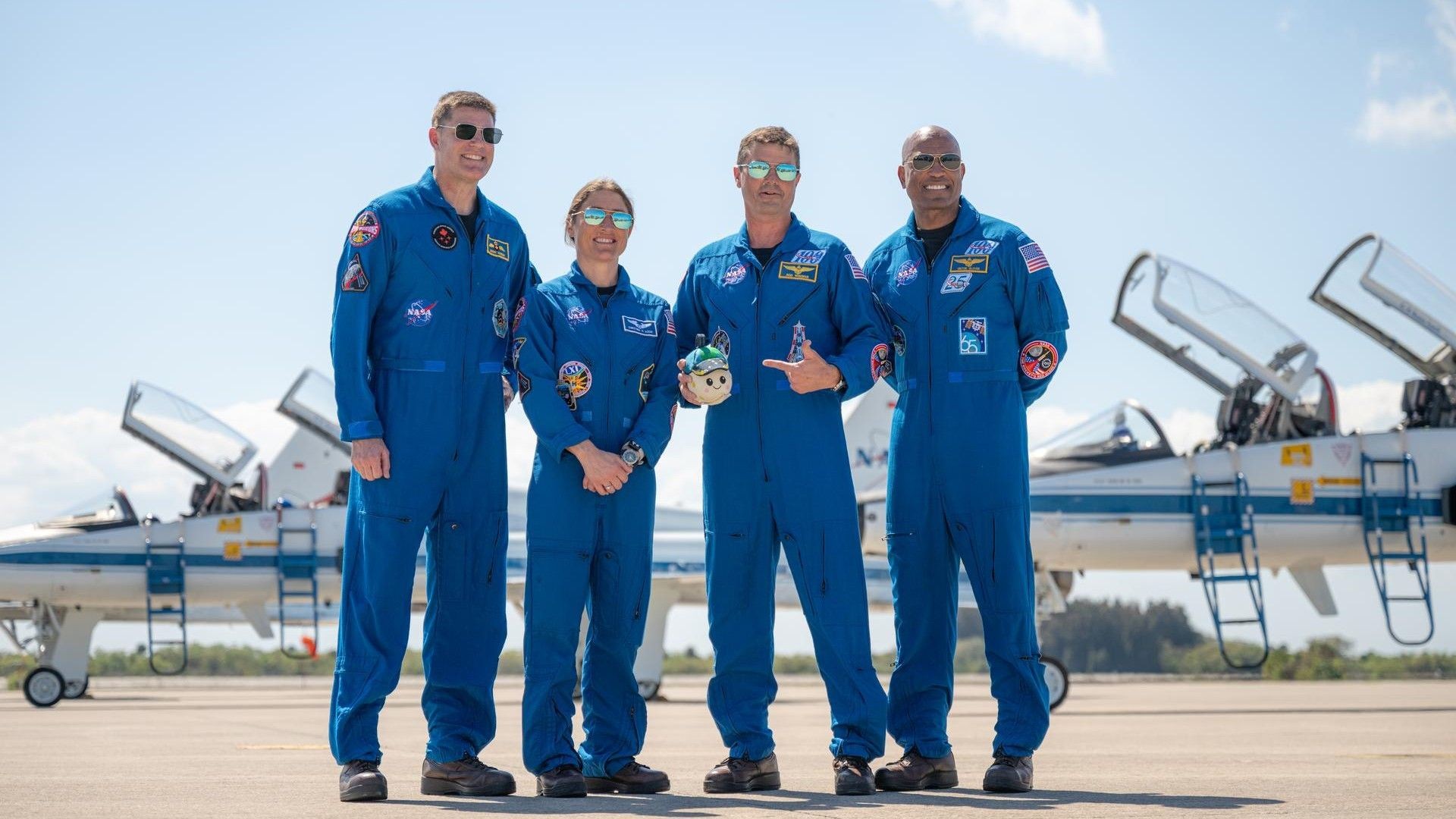
The four astronauts assigned to NASA’s Artemis 2 mission – Victor Glover, Christina Koch, Reid Wiseman, and Jeremy Hansen of the Canadian Space Agency – recently arrived at Kennedy Space Center in Florida, marking a significant step towards their historic lunar flight. Alongside preparations, the crew revealed “Rise,” their charming zero-gravity indicator designed to signal when they officially enter weightlessness.
The Significance of Zero-G Indicators
Zero-gravity indicators are a long-standing tradition in spaceflight. These small, symbolic items visually confirm when a spacecraft leaves Earth’s gravitational pull, as astronauts begin to float freely within the cabin.
Introducing “Rise”
“Rise” is a miniature plush moon, sporting a cap styled after Earth and adorned with starry details. The design pays homage to the iconic “Earthrise” photograph captured during the Apollo 8 mission – a powerful image of our planet rising above the lunar horizon. The indicator was created by Lucas Ye, a second-grader from Mountain View, California, whose design won NASA’s open call for submissions. The agency received over 2,600 entries from participants in over 50 countries, highlighting global excitement around the Artemis program.
Artemis 2: A Return to Lunar Orbit
Artemis 2 is set to be the first crewed mission to lunar space in over half a century, since Apollo 17 in 1972. The flight will rigorously test the Orion spacecraft and facilitate experiments crucial for future Artemis missions. The overarching goal of the Artemis program is to establish a sustainable human presence on the Moon, including the eventual construction of permanent lunar bases.
Launch Timeline
NASA is currently cleared for launch as early as April 1st at 6:24 p.m. EDT (2224 GMT). The Artemis 2 mission represents not just a technological achievement, but a renewed commitment to lunar exploration, pushing the boundaries of human spaceflight and inspiring the next generation of scientists and explorers.
The program’s long-term vision extends beyond simple return visits to the Moon, aiming for a permanent foothold in space that could eventually serve as a stepping stone for missions further into our solar system.