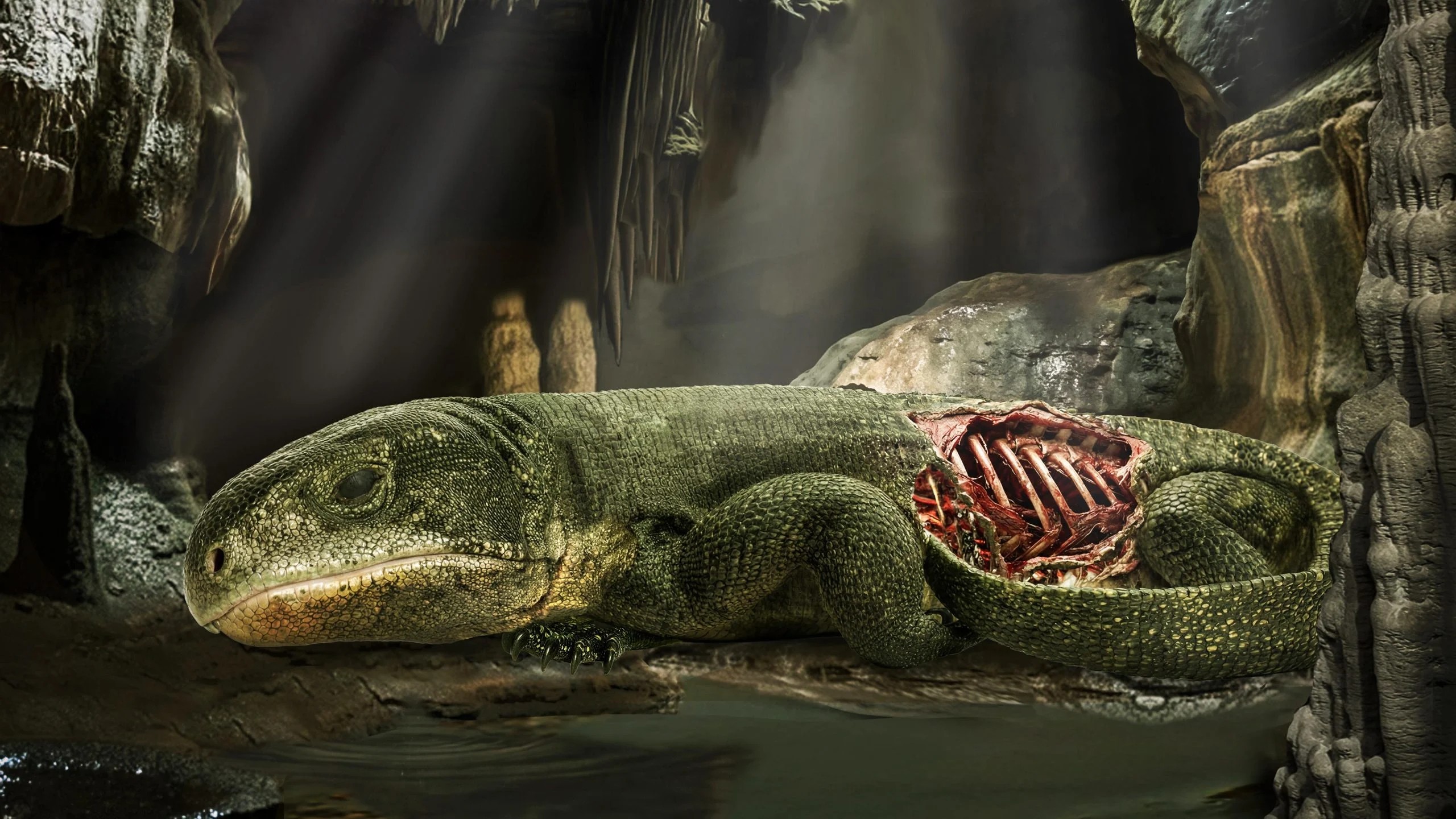
A remarkable discovery in an Oklahoma cave has provided scientists with a rare window into the deep past, revealing the exact moment a revolutionary breathing mechanism changed the course of evolution.
A mummified specimen of Captorhinus aguti —a small reptile from the early Permian period—has revealed the earliest known evidence of costal aspiration breathing. This method of using rib muscles to expand the chest cavity is the same fundamental process that allows modern reptiles, birds, and mammals, including humans, to breathe.
A Leap from Water to Land
To understand why this discovery is significant, one must look at the biological limitations of the animals that preceded these early reptiles. Most amphibians rely on “buccal pumping”—using their throat muscles to gulp air into their lungs—and often supplement this by breathing through their skin. While effective for many modern amphibians, this method is relatively inefficient and limits physical stamina.
The transition to costal aspiration breathing was a biological “game changer.” By using the ribcage to actively pull air into the lungs, early amniotes (the group containing reptiles, birds, and mammals) gained several critical advantages:
– Increased Oxygen Efficiency: Deeper, more consistent airflow.
– Higher Metabolic Potential: The ability to process more oxygen allowed for more vigorous activity.
– Greater Independence: Less reliance on moist skin for gas exchange, allowing animals to thrive in drier, terrestrial environments.
The “Mummy” of Richards Spur
The fossil was recovered from the Richards Spur site in Oklahoma, a location famous among paleontologists for its exceptional preservation of Paleozoic life. The specimen’s survival is due to a unique combination of environmental factors: oxygen-free mud and oil-seep hydrocarbons acted as a natural preservative, protecting delicate tissues that usually vanish millions of years ago.
Using advanced neutron computed tomography (nCT), researchers were able to peer inside the rock without damaging the specimen. This non-invasive scanning revealed:
* Three-dimensional skin: Featuring an “accordion-like” texture of concentric scales similar to modern worm lizards.
* Complex skeletal connections: A segmented cartilaginous sternum and specialized ribs that linked the ribcage to the shoulder girdle.
* Anatomical precision: The animal was found preserved in a natural position, with one arm tucked beneath its body.
Breaking Records in Molecular Preservation
Beyond the anatomical insights, the study published in Nature has shattered previous scientific benchmarks regarding the longevity of biological matter.
Using synchrotron infrared spectroscopy, the team detected traces of original proteins within the bone, skin, and cartilage. These protein remnants are approximately 100 million years older than any previously identified proteins in the fossil record. This discovery fundamentally shifts our understanding of how much biological information can survive across geological timescales, opening new doors for the study of ancient life at a molecular level.
The Evolutionary Legacy
The discovery of Captorhinus aguti does more than just describe an ancient creature; it maps the blueprint of a physiological innovation that enabled the rise of complex, active life on land. By mastering the mechanics of the chest cavity, these early pioneers paved the way for the diverse array of land-dwelling vertebrates that dominate the planet today.
This breathing system represents the ancestral foundation for the respiration seen in all living reptiles, birds, and mammals, marking a pivotal moment in the history of life.
Conclusion: The mummified Captorhinus provides a rare, high-definition look at the evolutionary shift toward efficient lung ventilation, proving that the way we breathe today was perfected hundreds of millions of years ago.