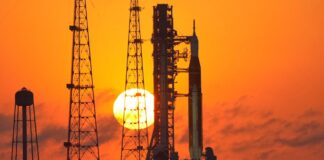
A retired British engineer who contributed to NASA’s Apollo 11 mission believes the upcoming Artemis II launch – the first crewed mission around the Moon in over half a century – represents far more than just a return to lunar orbit. Keith Wright, from Dorset, England, emphasizes that the Moon is a vital stepping stone for humanity’s long-term goal of reaching Mars.
From Apollo to Artemis: A Personal Connection
Wright worked at Kennedy Space Center during the Apollo era, preparing scientific instruments for deployment on the lunar surface. He even subtly marked his contribution by etching a Union flag onto a solar panel that remains on the Moon today. His involvement wasn’t just technical; he recalls a personal connection to the mission when astronaut Fred Haise spent an evening in conversation with his wife at a pre-launch party.
“It isn’t a joke – it is April the 1st and we are going back.”
The Strategic Importance of Lunar Missions
According to Wright, the Artemis program differs from its predecessor in that it is a truly international undertaking, with European nations providing critical components like the spacecraft’s propulsion module. But beyond collaboration, he argues that continued lunar exploration is essential for developing the capabilities needed for deeper space travel.
The engineer points out that Earth remains vulnerable to catastrophic events, making planetary diversification a necessity. Establishing a sustainable presence on the Moon will serve as a proving ground for technologies and strategies required for Mars colonization. The Moon offers a relatively close and accessible location to learn how to live and operate “properly off the planet.”
Humanity’s Future Beyond Earth
Wright frames the current push toward space exploration not just as scientific progress, but as a fundamental survival strategy. By expanding beyond Earth’s orbit, humanity can mitigate existential risks and ensure its long-term future. The Artemis II mission, and subsequent lunar efforts, are not merely nostalgic returns but calculated steps toward establishing a permanent presence in the solar system.
Ultimately, the Moon is not an end in itself but a critical platform for preparing humanity to spread its presence across the cosmos, with Mars as the next logical destination.