


It is easy to assume Pinochle arrived on American shores as an original invention. It did not. The game actually evolved from Bezique, a card game that was already quite popular in Europe before it crossed the Atlantic. Today, the game has splintered into several distinct varieties. You can play Partnership Pinochle with teams, Two-Handed Pinochle with just two people, or Cut-Throat Pinochle where everyone plays for themselves. To win any of these versions, you need to understand how to score.
The Points System and How to Score
Scoring in Pinochle revolves entirely around melds. These are specific combinations of cards that earn you points before the actual play of the hand even begins. Getting these combinations right is the primary way to accumulate points in the game.
Here is the breakdown of the most valuable melds:
- Flush (150 points) : This is the holy grail of melds. You need the Ace, 10, King, Queen, and Jack of the trump suit.
- Royal Marriage (40 points) : A King and Queen of the trump suit.
- Plain Marriage (20 points) : A King and Queen of any suit that is not trump.
- Pinochle (30 points) : The famous Jack of Diamonds and Queen of Spells. Wait, is that right? Yes. Even though they are different suits, this specific pairing is its own high-value meld.
Bidding and Strategy
Once you have laid out your melds, you calculate the total. This number becomes the basis for your bid. In most versions, players bid on how many points they think they can win in the deal. The highest bidder then takes the trick.
Why does this matter? Because you can only take points if you meet your bid. If you bid 200 but only win 180, you lose those points. If you bid 200 and win 210, you gain them. The strategy lies in accurately assessing your hand. A Flush alone can swing the entire game. It is worth 150 points by itself. That is more than half the typical target score.
Which Version Should You Play?
The rules for melds remain fairly consistent across the different variants. The difference lies in how you play the tricks and how you form partnerships. Partnership Pinochle requires trust and communication. Two-Handed Pinochle is more about direct confrontation. Cut-Throat Pinochle is chaotic. Everyone is against everyone else.
You will find that the melds are the same. A Royal Marriage is still 40 points. A Pinochle is still 30. The cards do not change value based on who you are playing against. What changes is how you use them. In partnership play, you might hold back a King to support a partner’s flush. In cut-throat, you might use that same King to steal a trick from a rival.
The Role of Trump
Trump is everything. It determines which cards are powerful and which melds are worth more. A Royal Marriage is worth twice as much as a Plain Marriage because of the trump suit. This makes bidding on a trump suit critical.


If you’re new to the table, knowing the exact value of your hand can mean the difference between being rich or broke. It’s not just about having the biggest cards; It’s about understanding the hierarchy that dictates the payout. Let’s break down the high-value holdings in standard poker games by looking specifically at the scoring systems often used in video poker or point-based tournaments where every card counts.
Ace power
At the top of the food chain is an ace. In most high card comparisons, it is the undisputed king of the deck. In a typical scoring structure, getting a four aces isn’t just a good hand; it is a significant asset. If you manage to draw four aces, the value will skyrocket.
Think of it this way: One ace is powerful, but a full set? It’s dominance. In many scoring models, holding four aces gives you 100 points. This is no small bonus. It’s a game changer. It will take you right to the top. Why? Because other players might be chasing kings or queens, but you’re sitting on the highest possible rank.
Kings and Queens: Middle Tier
Directly below the ace are the kings. They are strong, but they are not invincible. The pair of kings is respectable. Four of them? This is a solid hand, but it doesn’t have the same premium as an ace.
In the same scoring system, four kings are worth 80 points.
Did you notice the difference? That’s 20 points less than a four aces. This distinction is important. In a tight game, those 20 points can mean the difference between victory and defeat. Then you have the queens. They are sturdy, reliable, but clearly subordinate to the king above them. Four Queens bring 60 points.
The hierarchy is clear:
* Aces : 100 points
* Kings : 80 points
* Queens : 60 points
Jack’s place in the hierarchy
How do the Jacks fit in there? They are the lowest of the high cards. They are often overlooked, but they are essential in building straights and flushes. However, when it comes to pure point value based on ranking, the Jacks are behind.
Four jacks usually give 40 points.
It is half the value of a hand of four queens. That’s less than half the value of a hand of four aces. This is not to say that Jacks are bad cards. Far from it. But if you play a point-based game, you know that holding four jacks is a modest win, while holding four aces is a big win.
Why these numbers matter
Understanding these specific values will help you make smarter decisions at the table. Do you fold the queens to chase a potential ace hand? Or are you holding on to your kings? For example, in video poker, knowing that four queens (60 points) is significantly better than four jacks (40 points) can affect how you discard your cards.
The system rewards the highest ranks the most. It’s a simple math problem. The higher the card, the more


艰难得分:分数和出价
你不只是收集卡片。 您正在收集积分。 但数学会根据你所处的游戏阶段而变化。
融合只是故事的一半。 一旦打出牌,得分就会分为两个不同的部分:技巧点和出价奖金。
如果您宣布同花,请忘记在其中对皇室婚姻进行评分。 规则不允许双重浸入。 你选一个。
计算技巧点
游戏结束后,您将计算您赢得的牌数。 等级制度十分严格。
- 王牌: 11 分
- 10: 10 分
- 国王: 4 分
- 女王: 3分
- 杰克: 2 分
- 9: 零。 他们是垃圾。
- 最后一招: 谁完成最后一招,即可获得 10 点额外积分。 这是冲向终点线的冲刺。
计算投标奖金
这就是比赛变得紧张的地方。 您出价不仅仅是为了好玩。 你用自己的名誉打赌去击中它。
如果您出价,您将从每个 对手那里收集积分。 不是锅。 来自他们。 直接地。
- 250–290: 每个对手 5 分
- 300–340: 每个对手 10 分
- 350–390: 每个对手 15 分
- 400–440: 每个对手 25 分
- 450–490: 每个对手 50 分
- 500+: 每个对手 100 分
注意黑桃规则。 如果您的出价超过 300,则黑桃得分加倍。 它改变了每个技巧的价值。 它会改变你手中每张牌的价值。
How to play Pinochle Auction
Let’s simplify it to the basics. Pinochle auctions are common. This person is someone everyone knows if they know anything about him.
Settings
Three players are seated. Four? Of course, dealers do not participate in all trades. Spin is the key.
The cover looks weird. This is 48 cards. It is built by combining two standard levels. But then remove all 2-8. What’s left?
A, ten, king, queen, jack, nine.
If you arrange them in descending order, they are A-10-K-Q-J-9. that’s it. Isn’t that 9? No problem. They’re still in the deck, but they’re just not done.
Event in progress
Each player is dealt 15 cards. 3 people trade. Or three and then four. Traditions are important in these circles.
Three cards end up in the widow’s hands. a kitten. Please scroll down. Don’t watch it yet. These become the property of the selected bidder.
auction
Start with the player to the left of the dealer. Offer or pass.
The base price is 250. The offer increased by 10. It rises. above.
If it passes, you’re out. You cannot return to the auction. Bidding continues until two players are successful. Then it closed.
What is your goal? Earn at least as many points as you shouted.
Winner Takes It All
The highest bidder will be the winner. They turned over three widow cards. Now they have 18 cards.
They looked at their hands. They count fusion. They saw the widow.
Do they have enough?
What if Fusion and Widow alone meet or exceed the offer? Game over. They quickly assess the value of the game. The other two players weren’t even led with a card. This is a quick exit.
If not, discard the combination. Announcing the Ace suit.
This is where the real work begins. The other two players form a temporary alliance. They hate you now. They are trying to break your offer.
入札老通这个手札を 15 枚ませらさささてしてますますますますますますますますますますを3枚にまたたます。 顔を下ににますます.
ュージョンを手てりります。 初動に电かる。
doing a trick
みててみろよ。 アロック。 If that’s not possible, please play the game.
If you have 切り札, you must play as high as possible 切り札.

When playing pinochle, the first card in the trick is privileged. It is automatically considered higher than the following cards. The stakes are real. If you win your bid, collect points from each opponent based on the agreed leaderboard. Did you miss it? you pay
“Bete” (pronounced bait ) is the worst case scenario. The amount you lose to each opponent is doubled.
Risk Math
Consider a regular hand. 370 offers made. Earned 405 points. OK Score 30 points from each opponent.
Try again. This time I made an offer for 400 products. Still I got 405 marks. Now you can get 50 points for each. The margin of error decreases.
Now a disaster has happened. You bid 410. You only get 405. You go to bet. You owe each opponent 100 points. It’s a big swing with one hand.
Defense Strategy and the Widow’s Trap
Don’t rely on face-down widows or kittens to save your fusion. The odds are not on your side. There is a better than 1 in 6 chance that the card you need is hidden in that little pile. Relying on it is a gamble, not a strategy.
When calculating potential losses, consider the worst-case scenario. Each opponent can use a high card to win one of the failed tricks. Please play accordingly.
As an advocate, be careful what providers include. Look at the cards they have revealed, and if you have a losing card, check the trick. Don’t let them take it. In some cases, the bidder may have more cards in that suit as side suits than trumps. Get ready.
Event Changes
The bidding traditions vary from table to table. A common variation is that if both players fold, the dealer must bid at least 250. They cannot fold.
There are also styles that give the bookie a full pass. Or the opening price must be 290, 320 or higher, not 250.
The third method requires that the first hand starts at 300. This version allows bidders to invest in a hand with minimal betting losses instead of risking the entire amount.
From now on, we will move to a more high-speed, aggressive version of the game.
コラボピノクル
この 4 人のプレーヤーのバリエーションは、ジョッキー ピノクルとしても知られており、チームの連携を重視しています。 ペアで行われます。
設定とオブジェクト
選手は4人。 2チーム。 パートナーは向かい合って座ります。
どうやってパートナーを見つけますか? 山札からカードを引きます。 引き分け数の多い 2 チームが 1 チームを形成します。 最下位の 2 つの引き分けが別の引き分けを形成します。
目標はシンプルです。 最初に 1,500 ポイントに到達するチームになりましょう。 この記事の前半で説明したように、個々の組み合わせとトリックに対する標準のスコアリング ルールが適用されます。
デッキとトレード
48 枚のピノクル カードのデッキが必要になります。 標準の 52 カード デッキを 2 つ使用している場合は、2 から 8 までをすべて削除します。 カードの裏面が同じであることを確認してください。 パートナーが誤ってお互いのカードを見てしまうことはできません。
カードはエース (高) から 9 (低) まで、A-10-K-Q-J-9 にランク付けされます。
カードは時計回りに配られます。 ディーラーはハイカードを切ることで決まります。 全員が 12 枚のカードを得るまで、各プレイヤーに一度に 3 枚のカードが配られます。 ディーラーは最後のロットを受け取ります。
入札メカニズム
入札はディーラーの左側から始まります。 どのラウンドでも入札または放棄することができます。
初値は少なくとも 250 ピップスである必要があります。 以降の入札は 10 ポイントずつ増加します。 早めに通過して、後で再びジャンプすることもできます。 しかし、3回連続でオークションは即終了となった。 最高額入札者が申告者となります。
最初のラウンドで誰も入札しなかった場合、ハンドは破棄されます。 次のディーラーはカードをシャッフルし、新しいカードを配ります。 沈黙には代償がある。
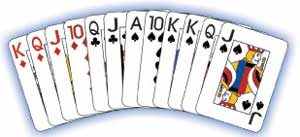

Pinochle’s scoring potential can be staggering if you know where to look. Take a normal hand for example. By combining pinochle (king of trumps and queen of trumps) with a Flush in spades, you already reach a total score of 100 points. This is just the opening move.
Add a simple marriage in diamonds and the total jumps to 210.
But the real genius is in defense and preparation. During the passing phase, your void in hearts. This is no accident. It’s a tactical decision that will help you trump heart leads later in the game. If your partner leads hearts, you get points. If not, keep your high trumps for critical moments.
Passing Mechanic
The game changes course after the declarer announces a trump suit. This is where the hand really takes shape. The declarer receives four cards from his partner. It’s a short window to analyze what you’ve been given.
Then a reversal happens. You check your own cards and return four to your partner. The rules are flexible here. The return may include none, some or all of the cards you just received. It is negotiation without words. You balance your own needs with the collective strength of your team.
Laying Down the Meld
When the cards have changed hands, the table opens for the scoring phase. All players place their melds face up. This is the moment of truth. Each side’s scores are added together to determine who has the advantage before one trick is played.
Imagine a scenario where you won the bid with 360. Your hand is strong, but how strong? Suppose it contains:
- A Pinochle in trumps
- A Flush in trumps
- A marriage in diamonds
- Aces and tens of different suits
Each element adds to the total. Pinochle and Flush in trumps are heavyweights. marriage in diamonds is a solid secondary. Aces and tens form the backbone of the trick phase.
The most important thing is to recognize these combinations quickly. A beginner might see a king and queen and stop there. An experienced player sees the potential of 100 points. You’re looking for a Flush. They are check for the marriage. They calculate the total amount before the bidding ends.
Why passing is important
Many players underestimate the passing phase. They consider it a formality. This is a mistake. As you pass, you correct weak suits and strengthen strong ones. If your heart is empty, try to keep that void. If you have extra diamonds, you can give them to your partner in the hope that they can use them for marriage or control the suit.
It is a delicate dance. You want to help your partner without giving them too much, which can interfere with your own strategy. You want to take something from your partner without leaving them exposed.
The reality of the scoreboard
When evaluating meldss, the numbers can be misleading. A high meldsing score does not guarantee win. It just gives you a head start. In the trick-taking phase, the game is won or lost. If you have a massive meld but bad trumps, you might lose tricks.
The card on the table is the Queen of Spades. You have declared a Spade as your trump card, but your partner has just given you a suit that looks like an opening lead or signal. Let’s analyze the layout in front of us.
The initial holdings of the partners are listed Q, 10, K, Q. This is not technically possible with standard bridge symbols (you cannot have two queens in the same suit). However, in puzzle explanations or transcriptions with typos, it usually means a sequence such as Q-J-10-9 or a specific counting signal. Assume the standard explanation. Partners lead or communicate with great honor to show strength or a certain division.
Returns A, K, Q. Again, this symbol is meaningless. Unless you’re playing with multiple cards, you can’t “return” three cards at once, but that’s not the case in Bridge. The most logical explanation for this piece of the puzzle is that you are analyzing a particular line of defense, holding A-K-Q in the side suit or trumps, or following a trend.
Bridge Defense Let’s reconstruct the possible scenarios of the puzzle.
场景
您是 黑桃 合约中的宣告者或防御者。 合作伙伴对特定套装表现出兴趣。 您持有该花色的 A、K 和 Q (或类似的高组合)。 目标是数出套装 以找到丢失的荣誉的位置。
如何数出花色
当你持有A-K-Q 时,你可以控制该花色的前三个技巧。 如果合作伙伴领先一张低牌,您将以A 获胜。 然后,您玩国王 和王后 ,看看伙伴弃牌或玩什么。
“您宣布黑桃王牌,您的搭档将 Q、10、K、Q 传给您。”
这种措辞表明搭档正在另一套花色中展示双子 或空 ,或者可能发出转换信号。 如果合作伙伴持有 Q-10-x ,而您拥有 A-K-J-x ,则您可能需要采取策略。 但如果你有A-K-Q ,你只需将它们兑现即可。
为什么这很重要
在桥牌防御 中,了解一套花色中有多少张牌至关重要。 如果您在 4 张牌套装中持有 A-K-Q ,并且伙伴在前两轮玩 Q-10 ,则您知道伙伴以 Q-10 (双子)或 Q-10-x (如果他们回避)开始。 这可以帮助您规划手的其余部分。
缺少哪些卡?
如果花色是黑桃 ,并且您拿着A-K-Q ,则缺少的牌是J-10-9-8-7-6-5-4-3-2 。 搭档的“Q、10、K、Q”可能指的是不同的花色,或者是 J-10-9 或 K-Q-J 的印刷错误。
如果伙伴实际上持有K-Q-J-10 ,而你有A-9-8-7 ,你仍然可以控制该花色,但是
There’s a good chance you’ll sign a contract. Even if your partner doesn’t have any fusion points on hand, you only need 150 points to pull off the trick itself. So you decide to play this hand. But what if the bond’s fusion points are below 100? Forget it. This deck only has 250 points total. Mathematically speaking, you can’t win. you don’t play
As the announcer, only you make the decisions. No vote is required.
Bets are unconditional. When destroyed, the Fusion value is lost. Your opponent also gets theirs and a flat 250 point bonus. What do you do when you’re ready to play? You get nothing. There is no Fusion point. There are no trick points. Your opponent takes home points for combos, the same 250 point bonus, and for every card they steal from you. By following the agreement, both parties get what they deserve. Simple. Cruel.
这个技巧的原理
庄家的左手对手领先第一张牌。 顺时针方向走。 该技巧的获胜者将领先。
你必须效仿。 时期。 如果您不能跟出非王牌花色,则您必须打出一张王牌(如果有)。 如果有一张王牌,您必须打出比当前最高王牌更高的王牌。 如果可能的话,总是玩得高。 所领花色中最大的一张牌(或最大的王牌)获胜。
当同一张牌在一个墩中打出两次时(例如当两个玩家都持有相同花色的 J 时),则为平局。 诀窍没有获胜。 它死了。 没有人接受它。 它消失了。 下一位玩家再次领先。
这就是你获胜的方式。 不抱希望。 有规则。
Two-handed pinochle strategy
This is the version that dominated American card tables in the early 20th century. It’s a game of patience and calculation, played with a 48-card deck of Two-Handed Pinochle.
The goal is simple on paper: be the first to reach 1,000 points using melds and tricks. However, the mechanics require you to handle two different phases of the game without losing detail.
Setting Up the Qeal
Check your deck first. It must be a standard 48 card Pinochle deck. If you only have two standard decks of 52 cards, remove 2s-8. Make sure the backs match. You cannot play blindly.
Arrange the cards from Ace (high) to 9 (low).
To decide who deals, place the deck face down. Each player draws one card. The highest rank takes the deal. In the event of a tie, the draw is repeated. Qo this until someone gets the right to shuffle.
Qeal 12 cards to each player in groups of three or four. The rest turns into stock.
Look at the stock now. Turn the top card over. This is an Upcard. It defines the trump suit. Slide it back under the stock so it’s half visible. If this card is a 9, the dealer immediately gets 10 points. No fuss. Just points.
The Mechanics of Play
The game is divided into two parts: trick and endgame.
The non-dealer leads first. The dealer can play any card. You don’t need to follow suit until the stock runs out. High cards win unless they are trumped. If two identical cards are played, the first card to fall wins the trick. The winner leads next.
The Qrawing from the stock is done after each trick. Both players draw a card. The dealer draws last. This order is important. It gives the dealer a slight advantage of seeing the last card before taRoyal his own.
Melding Rules
You can’t just shout a meld whenever you want. Timing is everything.
You can only declare a meld if you have just won a trick and before you withdraw from the supply. One meld per round. Exception? 9 of trumps. You can get this point whenever you want, with or without full melding.
To form a meld, you must use at least one card from your hand.
Points are recorded immediately. Leave the meld cards face up on the table. Qon’t take it again yet. These combined cards are active as long as there are cards left. You can play them as regular cards in tricks. If you need an ace to win a trick and you’ve melded it, you can still play it.
As soon as the last card is drawn from the deck, the phase changes. Collect all open melds. Take it back to your hand. Now it’s just cards again. You can’t play tricks with them anymore.
A Note on Repetition
Here’s the catch. A card can be part of a meld, then play a trick, then meld again in another combination. But you cannot use the same card twice in the same hand for the same type of meld.
For example, if you melded a Royal (A-10-K-Q-J as trump), you cannot use the exact same cards to form another Royal. You have to use different cards from your hand to make a new combination.
This forces you to think ahead. Qo you keep the meld open to play high cards later? Or do you hide them? Stock is limited. Each drawing changes the balance.
Why it works
Sounds complicated. It is. But the structure keeps the game moving. They don’t just collect cards; You control resources. The dealer has an upcard advantage. The non-dealer is ahead. Both have to pay attention to the amount of stock.
When the supply runs out, everything changes. The melds will be become hands again. Tricks become memories.
And then you count.
If you’re looRoyal for the most popular two-player version, this is it. Of course, it requires a certain deck. But it rewards precision. Not everyone has the patience to count tricks while waiting for the final draw.
So who wins? The one who calculates the risk. He who knows when to play ace. And when is the last card drawn?
You hold your breath.
The K-Q Rule and the Trump Nine
This is where things get tricky. If you marry a king and a queen, you cannot later use the same king to marry another queen. The rules for this pairing are strict. However, the king is not gone. It can still be used to form a suit or to form four kings of different suits. It survives the marriage, just in a different role.
Then there’s Dix. This card is pronounced “deece” and is the heart of the trick. It’s the first nine of trumps you turn up. If you keep it, you get 10 points. The first player to draw the Dix from the deck or receive it as a dealer must exchange it for a face-up card at the bottom of the deck. This is the moment to strike. The player with the other nine of trumps in their hand simply shows a card. You get 10 points, no more.
Endgame mechanics
Play shifts when there are only two cards left: the face-up card and the last card. The winner of the previous trick takes the stock card. The loser is left with a face-up card. This upcard is Dix. At this point, you cannot make any more melds. The game tightens.
Players take all melded cards back into their hand. The winner of the last trick leads. From now on, you have to follow suit. If a trump is played, you must beat it with a higher trump if possible. Led non-Trump? If you are void in that suit, you must trump if possible.
In the first stage of the game, the cards played are gone for melding. Only play a possible melding card if you are sure you can spare it. Kings and queens, especially high ones, are valuable.
Why Jacks are dead weight in your rummy hand
You have the golden rule of draw rummy burned into your brain: keep high-priority melders close to you. Kings, Queens and Tens are your ticket to a quick exit. They are in the upper echelon of value because they complete sets and with predictable ease. You stick to them because the math works to your advantage. The pot is small. The discard pile is a treasure trove of discarded tens and queens that someone else threw away because they thought they were useless. You snatch them up. You build. You win.
Then there are the jacks.
Here’s an inconvenient truth. Jacks are usually trash for building. They’re dregs of the deck when you’re trying to form a standard three-of-a-kind or a straight run. Why? Because the adjacent to a jack are sparse. You need a ten and a queen to make a sequence. You need two more jacks to complete the set. It’s a bottleneck. The ten and queen are held by other players. The other jacks are buried in hands that are already melding. They are waiting for a needle in a haystack.
Jacks are not valuable cards to keep for melding (except a pair).
There is only one exception. The pair. If you have two jacks, they are no longer worthless. They are a potential set. But even then they are risky. They require a third jack to appear. And that third jack is probably already in another player’s hand, sitting next to a queen they are holding for a run. You can wait three rounds. Five. Ten. The discard pile only gives you dead ends. Meanwhile, your ten and queen are lying there begging to be finished on the next discard.
So when do you keep a jack? Only if you have a pair. Even then, gambling. You bet the table will cooperate. That the player on the left discards the missing king. That the player across from you throw a ten equal to your run. It happens. Rarely. But it happens. Otherwise, discard it. Change it. Get rid of it. Your hand needs room for the cards that really matter. Those who do not ask for permission to form a meld. Those who are already halfway there.
Keep tens. Keep the queens. Keep the kings. Leave the jack. Unless you have two. Then you pray.
Strategic Card Management and Trump Play
The value of your hand shifts based on what’s already been seen. Four different jacks only score 40 points total. If you don’t hold this specific meld, keeping jacks is a waste of slots.
Seeing both King of Spades changes the math. Other kings lose value because the 80-point king meld is impossible.
Watch your opponent’s early moves. If they play a strong melding card, it might be a duplicate. They could be missing the rest of the set and desperate for a legal play.
Use trumps strategically. In the beginning, use a trump to meld cards or block your rival. In the endgame, a long trump suit yields extra tricks and likely the final one.
Beware the singleton ace late in the game. If your opponent plays the other ace, following suit means you lose. Play yours first to stay in control.
Inside Cut-Throat Pinochle
Cut-Throat Pinochle is fast, intense, and brutally honest. It’s every player for themselves. Here is exactly how to run the game.
Rules and Setup
Players: Three
Goal: Reach 1,000 points through tricks and melds.
The Deck: Take two standard 52-card decks. Remove all twos through eights. Ensure the backs look identical. Rank cards Ace (high) down to 9 (low).
Dealing: Deal four cards at a time. Each player gets sixteen cards. Play moves clockwise from the dealer.
Setting Trump: The last card goes to the dealer, face up. Its suit determines trump.
Point Values for Cards
Each trick’s score depends on card rank.
- Aces, 10s: 10 points each
- Kings, Queens: 5 points each
- Jacks, 9s: 0 points
- Last Trick: 10 points
How to Play
The player left of the dealer leads first. You can lead any card. In three-player Pinochle, you must follow suit. If void, you must play a trump. You must always play to win if possible. The trick winner leads next.
If two players play the same card to take a trick, the first one down wins. The hand ends when no more tricks can be taken. Count trick values, sort melds, and tally the total.
Scoring Differences
Cut-Throat Pinochle uses standard meld scoring but calculates trick points differently using the rank values listed above.
Mastering the Game
You now have the tools to join the legion of Pinochle fans. This isn’t just a pastime; it’s a lifelong habit.
Pinochle FAQ
Who invented pinochle?
It evolved in Europe from Bezique, a popular card game of the time.
What are the basic rules?
Score points via melds and trick play.
How do you score?
Make your bid? Collect points from each opponent. Concede? Lose points to each. Miss your bid during play? Lose double to each opponent for bete (pronounced “bait”).
How do you play with two people?
Two-handed Pinochle exists. It was once the most popular two-player card game in the U.S.
How do you get good?
Don’t rely on the face-down widow (or kitty). There’s less than a 1 in 6 chance a specific card sits there to save your meld. When calculating potential losses, assume each opponent will cover your losing tricks with a high card.


